Artificial intelligence is beginning to change work in a way that feels both gradual and sudden. On the surface, many jobs still look the same. People still answer emails, prepare reports, manage customers, analyze spreadsheets, write proposals, and coordinate projects. But underneath those familiar job titles, the work itself is starting to shift. Tasks that once required hours of routine effort can now be drafted, summarized, sorted, or automated by software. That does not mean human work disappears overnight. It means the value of human work starts moving.
That shift is where many workers now feel uneasy. The fear is often framed as a simple question: will AI replace my job? But that is usually the wrong way to think about what is happening. In many cases, AI is not eliminating an entire profession at once. It is removing pieces of work, compressing timelines, reducing the need for junior support, and changing what employers expect one person to be able to do. The deeper challenge is not only replacement. It is adaptation. The people who learn how to work with intelligent systems are likely to become more valuable, while those who remain tied to purely routine work may find themselves under increasing pressure. That framing fits the broader Life After AI approach: reader problem, AI shift, and practical response, with the focus on how individuals can adapt and benefit.
What is happening is not just automation in the old industrial sense. This is a different kind of transition. AI systems are now moving into cognitive and administrative tasks that were once considered distinctly human. They can draft first versions, classify information, summarize long documents, generate ideas, answer basic customer questions, create simple visuals, and assist with analysis. In the project materials for Life After AI, the underlying narrative is clear: AI is restructuring work and removing many routine tasks, but workers who learn to direct AI systems can reach higher productivity and new career paths faster than before. The focus is not fear for its own sake. It is practical adaptation.
That matters because routine work has long served as the entry point to careers. A person starts by handling repetitive tasks, learns the environment, builds judgment, and gradually takes on higher-value responsibilities. AI threatens part of that ladder. The knowledge library for this project explicitly frames labor market transformation as restructuring rather than simple elimination, and it identifies pressures such as job displacement, workforce restructuring, productivity gains, and the erosion of traditional entry-level pathways. In other words, the economy is not just losing tasks. It is changing how workers become useful in the first place.
Want a practical next step?
Get the free AI Career Survival Checklist for practical ways to stay useful as AI changes hiring.
This is why adaptation now matters more than reassurance. Workers can no longer assume that competence means simply doing assigned tasks efficiently. Increasingly, competence means knowing which tasks should be done by a machine, which require human judgment, and how to combine both into a better result. The worker who can use AI to speed up research, improve drafts, test ideas, and reduce repetitive effort may produce far more than someone doing the same role manually. That does not make human skill less important. It makes human skill more selective. Judgment, taste, trust, accountability, communication, and context become more valuable because they are the things that sit on top of automation rather than underneath it.
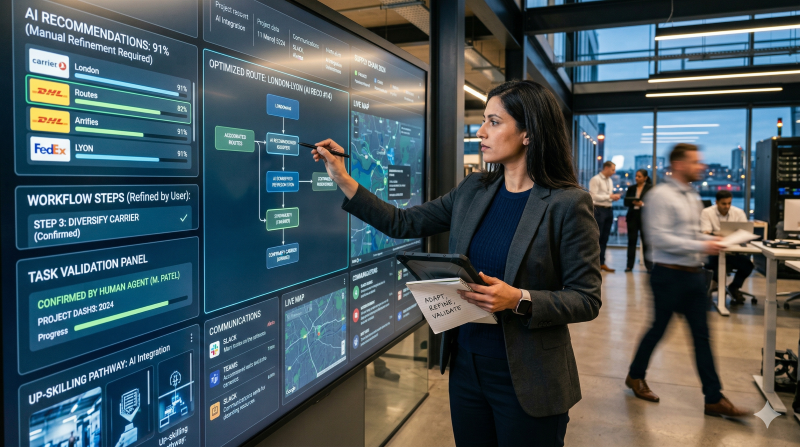
For many people, this will feel unfair at first. Entire careers were built around mastering a workflow that is now being compressed. A junior employee who once proved their worth by summarizing meetings, organizing data, preparing first drafts, or handling routine customer interactions may now be competing with software that does those things instantly. But the wrong response is to compete directly with the machine at the level of repetition. That is usually a losing game. The better response is to move upward into supervision, integration, decision support, quality control, and outcome ownership. The worker of the near future may be less like a single-function operator and more like a director of systems.
This is where many people get the transition wrong. They assume adaptation means becoming a programmer, a machine learning engineer, or some kind of full-time technical specialist. For most workers, that is not the real requirement. The real requirement is becoming AI-augmented. The topic list in your source files points toward this directly with themes such as becoming AI-fluent, turning AI into a personal mentor, making yourself AI-augmented at work, and learning a new profession with AI tools. That is a more useful and realistic path. Most workers do not need to build frontier models. They need to use available tools to improve their output, sharpen their thinking, and expand what one person can deliver.
Another common mistake is assuming that adaptation is mostly about tools. Tools matter, but tool-chasing by itself is not a strategy. New products appear every week. Interfaces change. Features shift. A person who spends all their time hunting for the newest app without building durable judgment may stay busy without becoming more valuable. The durable layer sits underneath the tools: the ability to ask better questions, define useful outcomes, evaluate weak output, spot hallucinations, structure a workflow, and remain responsible for the final result. That is the real skill premium. AI changes quickly, but good operators retain value because they can think clearly about what needs to be done.
Workers also underestimate how much adaptation is psychological. Many people still relate to work in a passive way. They expect the employer to define the role, the software to stay stable, and the ladder to remain recognizable. The AI economy punishes that mindset. It rewards workers who are willing to redesign their own job around better leverage. That may mean documenting recurring tasks, identifying repetitive work, experimenting with automating part of it, and repositioning oneself around faster delivery and better decisions. It may also mean accepting that some old status markers will matter less. In the past, being busy could signal value. In the AI economy, leverage matters more than visible effort.
So what should workers actually do?
The first step is to identify which part of their current work is routine, repeatable, and rules-based. Anything that follows a predictable pattern is a candidate for AI assistance. Drafting standard emails, creating summaries, organizing notes, extracting key points from documents, generating first-pass content, building simple reports, and translating rough ideas into structured output are all areas where AI can often help. This does not mean handing over the entire job. It means separating the work into layers and using AI where it reduces time without reducing accountability.
The second step is to build a personal workflow rather than relying on random one-off prompts. Workers should learn how to use AI in a repeatable sequence. For example: collect notes, ask AI to summarize, ask it to identify missing questions, ask it to produce a draft, then review and rewrite the final version with human judgment. That kind of workflow turns AI from a novelty into a productivity multiplier. It is also safer, because the human remains in charge of verification and final decisions.
The third step is to strengthen the non-automated layer of their value. That includes judgment, communication, prioritization, relationship management, trust, and domain understanding. In most workplaces, the final bottleneck is not raw output. It is knowing what matters, what can be trusted, what should be escalated, and what outcome actually helps the business. AI can generate options. It does not own the consequences. Workers who become known for reliable judgment will remain valuable even as generation becomes cheap.
The fourth step is to use AI as a training partner, not just a task tool. One of the most underused advantages of AI is that it can help workers learn faster. A person can use it to explain unfamiliar concepts, rehearse interviews, break down a new field, simulate objections, create study plans, and accelerate skill acquisition. That matters because adaptation is not only about improving the current job. It is also about shortening the distance to the next one. Someone who can learn a new workflow, industry, or adjacent skill faster has a better chance of surviving a market that is constantly shifting. The source materials explicitly position AI as a mentor, an augmentation layer, and a way to learn new professions faster.
The fifth step is to think in terms of outcomes rather than tasks. Employers increasingly care less about how many hours a person spent and more about whether the result was correct, useful, and fast. That can work in a worker’s favor if they learn to produce stronger outcomes with AI assistance. A marketer who uses AI to test angles faster, an operations worker who automates routine reporting, a salesperson who uses AI to prepare better call notes, or an analyst who uses AI to surface patterns more quickly may all become harder to replace, not easier. The key is that the person is not just operating the tool. They are owning the result.
The workers who struggle most may be the ones who stay in denial too long. They will keep doing work manually because that is how they learned it, or they will dismiss AI as low-quality because early versions were inconsistent. That is a dangerous comfort. AI does not need to be perfect to change labor demand. It only needs to become good enough, cheap enough, and integrated enough that companies redesign workflows around it. Once that happens, workers are judged against a new baseline. The market rarely waits for everyone to feel ready.
Still, adaptation should not be confused with surrender. The answer is not to become dependent on AI for every thought, every paragraph, or every decision. That creates its own weakness. The strongest position is one where AI expands capacity but does not replace understanding. Workers should still know how to think, evaluate, question, and decide. Otherwise they risk becoming operators of systems they do not truly control. Real resilience comes from combining human judgment with machine leverage, not replacing one with the other.
The future of work will likely belong to people who can move fluidly between both worlds. They will know when to automate and when to slow down. They will use AI to reduce friction without giving up responsibility. They will learn faster, produce more, and think more clearly about where human value still matters. In that sense, the AI economy is not just a threat to workers. It is also a pressure test. It reveals who is willing to evolve from task execution into intelligent coordination.
The old promise of work was that if you learned the process and stayed in the system long enough, the system would gradually reward you. The new reality is less stable, but it also creates a different kind of opportunity. Workers who become AI-fluent, AI-augmented, and outcome-focused may be able to move faster than older career structures ever allowed. The transition will be uneven. Some people will be pushed out. Some roles will shrink. But others will use this moment to become far more capable than their job title suggests. That is the real adaptation challenge now: not just keeping a job, but redesigning your usefulness before the market does it for you.
What To Do Next
If this article made you realize your current role may be changing faster than expected, start with something practical.
Get the free AI Career Survival Checklist to help you:
- identify which parts of your work are most exposed to automation
- find areas where AI can increase your value instead of reducing it
- build a clearer starting point for becoming more AI-augmented at work
If you want a deeper system, explore the AI Career Survival Toolkit. You can also join the Life After AI newsletter for practical insights on adapting to AI-driven change.
